Time for Plan B?

Predictably, the heat is mounting on the British government to soften its fiscal policy in light of weak economic growth.  Today the new IMF chief Christine Lagarde seems to be adding to the pressure, even if she wasn’t explicit.  The code for changing this policy is referred to by political types as “Plan B”.  I am now convinced that some sort of Plan B may now be a good idea – but it would not take the form that a lot of Plan B advocates, especially the Labour opposition propose.

First, why?  I have been progressively convinced by the FT’s economics editor Martin Wolf.  I have found him to be easily the most cogent commentator on the current economic situation, better than any number of economics Nobel Laureates or former members of the Bank of England monetary policy committee, who seem to think that their past glories can compensate for the shallowness of their analysis.  Paul Krugman, Ken Rogoff, Joseph Stiglitz, to name a few, have disappointed somebody that has respected their weightier works; David Blanchflower has turned downright silly in order to widen his audience.  Mr Wolf has been consistent, logical, and has gone further than most to try and understand all facets of the arguments.

The problem in the UK economy is not lack of consumer demand, since consumers are right to pay down debt as a priority right now.  The problem is lack of business investment, and a weak world economy, and hence potential export markets.  And excessively tight fiscal policy may send investment into a doom-loop, since so much depends on confidence.  Add to that the fact that current levels of public expenditure are unsustainable, and the massive size of the public deficit, and you will understand that most versions of Plan B are unconvincing.  Reducing the cuts simply creates problems for later, and builds up a false confidence in what this nation can afford.  Cutting VAT temporarily, as advocated by Labour,  addresses the wrong problem.

The answer must be to promote investment.  As Mr Wolf points out (here but behind the FT paywall), there is a golden opportunity for the government to do so because its borrowing costs are so low.  The trick is finding projects that deliver a convincing financial return; borrowing against such projects does not undermine the country’s finances.  Unfortunately this is easier said than done.  A lot of public projects make extravagant claims about their worth, but are in reality wasteful prestige initiatives – think of the Building Schools for the Future programme.  Or else they turn out to be so badly managed that promised returns are never delivered – think of NHS IT, or Edinburgh trams, or anything undertaken by the Ministry of Defence.

There is no doubt some scope for increasing funding to standard public projects.  But actually what needs to be done is to provide more support for medium sized and small businesses, especially growing ones.  The banks are not stepping up to the plate, demanding ludicrous returns for their efforts.  Surely there is scope for the government to beef up regional development funds and increase funding for institutions such as the Green Investment Bank.  This will not open the floodgates to usher in an era of rapid growth.  But surely it would help.

The Euro: Thatcherism by other means

It’s a grim time for supporters of the Euro project like me.  Hardly a day goes by without hearing some highly patronizing person going on about how a country fixing its exchange rate is a terrible idea  because it can’t then devalue when it hits trouble, and how the austerity policies in the Euro zone are doomed to fail.  One irony is that many of these people are from the the political right; the sort of people who think that the Thatcher revolution of the 1980s was not just a good thing, but a turning point for the British economy.  In fact the Euro advocates are proposing very similar medicine for southern Europe.

The UK economy inherited by Mrs Thatcher in 1979 was a mess.  Both unemployment and inflation were persistent, and the country was referred to to as “the sick man of Europe”.  Mrs Thatcher’s solution was to focus on the long or medium term drivers of success, with utter contempt for short-term palliatives.  She progressively liberalised the economy, and in particular the labour market, then dominated by trade union power, and taxation, which had reached punitive levels on the rich (and not so rich, come to that).  In macroeconomic policy she believed in squeezing down inflation through tough monetary and fiscal policies.  Interest rates soared.  Amongst other things, the pound rapidly appreciated.  This was all part of the medicine.

The results were indeed dramatic.  Unemployment got much worse, with devastation sweeping through great swathes of industry – all of which makes our current troubles look like small beer, even though, according to GDP statistics, we are supposed to be in a worse mess now.  But in due course the economy prospered and reached undreamed of heights – though some parts of the country never recovered.

Back to the Euro zone.  The underlying problem with all of the currently struggling economies, except Ireland maybe, is not entirely dissimilar to that faced by Britain in 1979.  A host of product market, labour market and tax inefficiencies have conspired to make their economies relatively uncompetitive.  The political will to tackle these problems has been lacking.  Before the Euro they could simply let their currencies slide to offset this lack of competitiveness.  But all this did was to ensure that the living standards of citizens stayed below their potential.  And it was unsustainable in the long term; eventually you get to stagflation and even hyperinflation – a fate which Portugal in particular was reaching before the Euro project offered rescue.  Once in the Euro devaluation is not an option, and so politicians have to focus on medium and long term reforms.  This is what they are now doing, some with more enthusiasm (say Portugal) than others (say Italy).

Mrs Thatcher, of course, would never approve of a country joining the Euro – she treasured national sovereignty too much – but she would have approved of many of its consequences.  Mrs Thatcher did not believe in devaluation.

But this is hardly an advertisement for the Euro for many.  A lot of people still think that the Thatcher years were a period of gratuitous violence with adverse consequences that we are still suffering.  It was she that was responsible for the trashing of so much British manufacturing, with the appreciating pound very much part of this.  And the work she started was capably continued by Messrs Brown and Blair, since a high pound, together with aggressive exporting practices from China and India, had a similar effect in the 2000s – albeit compensated by unsustainable jobs in finance and building.

And there is no avoiding that the southern European economies need to go through a process of harsh economic reform, or else suffer a slow slide into poverty.  Euro advocates had always foreseen this; what they had not foreseen was that reduced government borrowing costs once in the Euro would allow these countries to put off the evil day, only to make it infinitely worse when it arrived.

Is the Ebacc such a bad idea?

Michael Gove, the Education Secretary for England (his remit not extending elsewhere in the UK, so far as I know), is one of the more controversial figures in the government.  I haven’t met anybody that works in or with the education sector that approves of him.  But amongst politicos and journalists, especially right-wing ones, he is considered one of the government’s best performers.  He is widely reviled by Liberal Democrats.  But not everything he says is nonsense.  And indeed the controversy he stirs up reveals some uncomfortable things about our educational establishment.  Today I am looking at one of his many controversial ideas: the English Baccalaureate, commonly referred to as the “Ebacc”.

What is it?  In principle the Ebacc is a certificate awarded to pupils who get C or better grades in five or more GCSE subjects, which must include maths, English, a foreign language (including Latin or ancient Greek), science, and history or geography (for more details see the link above).  Actually I’m not sure that it is a certificate yet; it was introduced last year as a performance target to show how well schools were doing in teaching these “core” academic subjects.

Why is it so controversial?  In the first place because it was dropped on schools out of nowhere last year, before they had a chance to plan for it.  Critics say that it should have been “tested” and phased in.  There may be some pupils who suffer because employers will be looking for their Ebacc when the school had put them in for some other subjects before they knew about it.  There is a lot of upset from schools who had looked good in earlier league tables that don’t look so good under this one.  This is mainly whinging by professionals who spend too much energy gaming the system to look good in league tables rather than considering what is best for their pupils.  To be fair, of course, many of the people I am dismissing as whingers actually have a more fundamental disagreement with the idea.  I am coming to that.

Also there are some more practical issues about how schools will respond.  One blogger (Anastasia de Waal of Civitas, quite sympathetic to the idea of a more academic curriculum) worries that schools won’t bother with pupils that they don’t think are going to reach C grades in one or more of these subjects.  This goes to the heart of another question: that of the use of league tables and performance measures.  A big topic for another day.

But the real controversy is about the subjects that aren’t included.  There are some subjects, such as religious studies and philosophy, that are (or should be) quite academic.  Why not include these if they test the same skills?  But the real issue is a whole swathe of “applied” or “vocational” subjects which have found their way into the GCSE.  These include applied sciences, applied languages (don’t ask), and things such as ICT (information and communications technology) and media studies.  These subjects were designed for pupils characterised as less academic, and were popular in schools because it was easier for students to get better grades.  By focusing on the more academic topics, the critics say, you are letting down all these less academic pupils from typically poorer backgrounds.

But the problem is that these “less academic” subjects are a major failure.  They are based on a misconception of what secondary school education at that age should be about.  They are, or so I understand, largely based on knowledge transfer, and not deeper understanding.  Pupils learn answers by rote and splurge them out as required.  But even supposing retention is good for this type of study, this knowledge is soon out of date.  What higher education recruiters and employers want, even for practical jobs, is understanding.  The “academic” subjects are much better at teaching this.  A college running a technology course would much rather its pupils were taught mathematics to a decent standard than any amount of ICT teaching (though schools have long been required to focus on maths and English).

This criticism makes a lot of sense to me, though I have only been involved in secondary education as a pupil, and that a long time ago.  For accountancy it has long been said that good basics (especially maths) is all that you really need from school – the rest can be picked up pretty quickly later.  When recruiting staff, I must admit that I didn’t take all that much interest in school qualifications if there was anything else (such as work experience) to go on.  And I find the idea of doing an applied subject without doing the theory alongside it to be equally flawed.

What am I saying?  At GCSE level a broad choice of subjects does not make for good education.  You need to focus on a range of basics and do them well.  Some regard the choice of subjects in the Ebacc as perverse, when other topics are equally as good.  I’m really not sure about that.  I don’t see that either religious studies or philosophy are good candidates to push out history or geography, or still less a foreign language.  Philosophy surely best after GCSE; I just don’t believe that religious studies is as stretching or socially inclusive as history or geography.  In my day I did a standard set of O levels, all in the Ebacc range (except English Literature); I never found that limiting.

What of the pupils who don’t make the Ebacc standard?  A very real problem – but the “applied” and “vocational” GCSEs were never the answer.  Better teaching and higher expectations are.  The more I see of the educational establishment, the more I am convinced that too many are content with the mediocre.

There is a final irony.  Mr Gove and his supporters often criticise modern education for lacking a focus on facts.  Actually the more academic subjects they advocate are mainly about skills, not facts.  They teach you how to think.  The less academic subjects fail because they are too focused on facts.  Of course you might argue that history and geography are, or should be, fact-based – but don’t get me started on that!

British banks shoot themselves in the foot.

Oh dear!  The Vickers review on banking reform hasn’t been published yet, and the news is full of people taking positions and what it might or might not recommend.  I have a lot of sympathy with our Prime Minister, who wants the blessed thing to be published before we have a row about it.  What to make of it?

The reporting is a bit confusing.  The Independent has hyped the thing up to be a war between the Vince Cable and George Osborne, not so much about the proposed reforms, but how quickly they will be implemented.  Meanwhile somebody has briefed the FT that Cable has pretty much given way on timing so there is no real row at all.

The proximate cause of this flurry is a lobbying campaign by the banks.  This campaign will do nothing to redress their general aura of incompetence.  They are basically saying the reforms should be kicked into the long grass because they will interfere with their lending to British businesses, which is critical if business investment is going pull us out of the economic doldrums, as most people hope.  There is some merit in this, because some of the reforms (on capital requirements and liquidity) could have just that effect.  But the ineptitude of their stance is staggering.

Politics is built on simple messages, and the banks are offering the Liberal Democrats a very tempting proposition.  This is a wonderful opportunity for them to show what they are doing in government by showing that they are resisting pressure from the banks.  As the banks themselves continue to insist on paying large bonuses for reckless trading activities, this is a popular stand.  Ed Miliband and Labour have not been slow to take up the anti-banker sentiment.  The Tories, meanwhile, don’t seem to know what’s hit them, and none of their side are sticking their necks out on the banks’ behalf.  Meanwhile John Cridland, the CBI director general, has weighed in on the banks’ behalf calling a rapid implementation of the reforms “barking mad”.  It is difficult to understand what he thought he was doing; the CBI’s credibility has been badly damaged as a result.

There may not even have been much of a row in the coalition in the first place.  There is consensus on the general thrust of the reforms; no doubt Vince Cable was quite flexible on the timings of some aspects, provided others proceed fairly quickly.  Now it is important to him and the Lib Dem part of the coalition that they are seen to get results.  A public row makes things worse for the banks.  If ever there was a time for quiet lobbying based on dry details, this was it.  Using the megaphone is totally counterproductive.

Not that I have much sympathy with the banks.  They are making too much money, and any sensible reform would reduce their profits, both by taking away the implicit government subsidy and by increasing competition.  It’s bound to hurt.  If the banks want to take some of their activities, and even their HQs, elsewhere, then so be it.  I’m not actually sure where they would go though.  Switzerland has dramatically increased its capital requirements for banks, and the stratospheric Swiss franc doesn’t make operating there cheap.  If they don’t have the implicit backing of a big government then their business model breaks down anyway – ruling out places like Ireland and Bermuda.  Going into the Eurozone when its own banking system is under incredible stress hardly looks a good idea either.  In America they have a habit of sending bankers to prison.

The central reform is to separate banks’ trading activities from their “ordinary” ones of taking deposits and lending to the public and non-financial businesses.  This was quite contentious in the commentariat when it was first mooted a year or so ago.  But there seems to be a much greater consensus behind it now.  Who would have guessed it?  A lot of people assumed the bankers would get away with it while politicians tried to make up their minds, and the disaster of 2007/08 faded into the memory.  Not so.  The banks’ inept PR machinery can take some of the credit.


Accounting for Libya

So now we are in a sort of endgame in the Libyan war.  It is not over, but Gaddafi’s government has been decisively beaten.  This outcome arises despite a constant stream of scepticism amongst experts and commentators, right from the start, and from a broad political spectrum.  I was not one of these sceptics, and I must admit to being annoyed by the patronising tone of much of it, assuming that politicians and supporters were muddled naifs who had failed to learn from history.  While these sceptics rapidly move on to point out the considerable difficulties that will arise in rebuilding the country, I feel that some accounting is called for.

As I said at the time, Libya’s situation was unique.  It’s geography is such as to make air power particularly effective.  Gaddafi’s rampant egotism had made him diplomatically isolated, tolerated by his allies and not liked.  In spite of claims by many that there was no clear strategy for the intervention, the strategy was clear all along.  Use air power to protect the existing rebel strongholds and then strangle the Gaddafi regime.  After this it would basically collapse from within.  This was mainly about momentum and morale.  Apart from a core of die-hard loyalists, who had much to lose from regime change, the regime’s power depended on two sources of support: loyal tribes and mercenary soldiers.  These would only be effective as long they thought the regime was going to win.

And so it has transpired.  The fall of Tripoli was remarkable.  Yes the core loyalists fought hard, and they are still there – but there were not enough of them, and they seemed to lack organisation.  The mercenaries had melted away into thin air.  The sympathetic tribes just looked on.  The turning point seems to have been the cutting off of the capital from succour coming in via the Tunisian and Algerian borders.

None of this is hindsight – seem my post last March.  What annoys me about the many critics is their inability to look beyond the generalities to the specific facts of the case.  To them, it was this way in Iraq, so it will be this way in Libya.  I am afraid that this kind of unthinking generalisation is a general disease right across modern society, and especially amongst people counted as experts.  From medicine to economic policy.  People don’t bother to analyse the particulars of the case, simply spouting forth the general rules with confidence.

It is too much to hope this will change.  But we fight on.

Seeing with the eye of faith

A little while ago I blogged on the subject of Islam and the modern world, following the BBC series on Mohammed.  This included some rather dismissive comments about Christianity, which I contrasted with Islam in some rather unfavourable ways, at least with regard to consistency.  Unsurprisingly this annoyed a (Catholic) Christian reader, and we subsequently engaged in a prolonged Twitter conversation, mainly about the crusades.  Twitter isn’t a good medium to explain ideas, and I feel strangely compelled to explain myself properly, even though I am not going to persuade anybody to change their views.  My point is this: I hold my views on Christianity not through ignorance but through a lack of faith.  This has led me to rather a long post, taking me through my own Christian journey.

Faith is an important part of any religion – and any relationship in fact.  To be a Christian you have to subscribe to a whole series of beliefs which you take on trust.  It’s your membership subscription, or, more aptly, the club rules.  You believe these things because you are a Christian; you not a Christian because you believe in them.  Or mostly, anyway.  People will be drawn to the faith because they come to believe, through reflection or experience, in some critical parts of Christian gospel; they then take the rest on trust.  For me I was drawn to the faith in the first place because I believed in my church community and wanted to be part of it; subsequently I was overwhelmed by the truth and beauty of the message of love, forgiveness and redemption that came through in the Gospels and the early Epistles of St Paul.  I lapsed mainly because the burden of faith became too much to bear – the accumulated superstructure of doctrine.  In my heart of hearts I could not believe that God is a person who intervenes in the world beyond the workings of immutable natural laws; neither can I believe in any meaningful afterlife, certainly in the sense of heaven, hell, judgement and so forth.  But I am a secular agnostic, not an atheist.  I am sometimes moved to take Communion in a C of E church service, on the rare occasions that I attend.  It is not inconceivable that I will come back to the faith one day, provided I’m not pushed too hard on the infrastructure of beliefs.

I was brought up as a Church of England Christian.  Both my parents had a strong faith, and took a philosophical interest in it and we talked about Christianity a lot as a family.  My mother’s father was a canon and professor of divinity (at Oxford), though he died long before I came into the world.  Our house was full of religious books, and my mother, who had a degree in Philosophy, studied theology and comparative religion as a mature student.  Our church was rather High, in the jargon of the C of E, meaning that it liked a lot of traditional, catholic rituals.  The biggest controversy at the time (it was the 1970s) was whether women could be ordained to the priesthood – my parents strongly beleived they could, but some of our clergy did not.  At university (Cambridge) I fell in with a much more “Low” group in the Christian Union, associating with Methodists and Baptists.   Here the issues were mainly about how to interpret the Bible, with a strong fundamentalist faction.  I had something of an intense religious experience while meditating in a retreat, as the message of love seemed to explode out of the New Testament in a burst of light.  That experience remains with me still, but I started to lapse pretty much as soon as I began to live on my own in London.

Two experiences in particular stand out in as I passed over the invisible line between faith and agnosticism.  I attended one my local churches (St Mary’s Islington), and the preacher considered at length whether dancing was to be allowed under scriptural rules.  Although he came to the right answer so far as I was concerned (yes), I was appalled by the idea that talking about these sorts of rules was an important part of church life.  In a second instance I visited a packed evangelical service in Nottingham with a couple of university friends.  The preacher there was developing the theme that the Apocalypse was near.  One his arguments: “The price of gold has trebled in just a year [or some such statistic]: that means that the value of money has fallen by two thirds!” – to a chorus of approval.  This dates the story to about 1980, the last time the price of gold shot through the roof.  To me then, as now, this is utter drivel.  Ever since I have had a visceral hatred of the use of gold as a substitute for money.  But more the point I thought to myself: “Why do I have to put up with all this nonsense?”

And so my views of on Christianity became very detached, as I was liberated from the eye of faith.  I have come to see it as a very interesting human phenomenon, and not a process of divine intervention.  It is an outgrowth from the Jewish faith, promulgated by a few years of radical and inspring preaching by Jesus Christ.  Something strange happened on Jesus’s death; his followers became inspired to accept Jesus himself as divine, and to spread the religion further.  There were several strands to this outgrowth, but the most important to us in the west was that of St Paul, who took the message to the Gentiles.  The faith was the right idea at the right time and its popularity exploded.  It survived persecution, with its adherents apparently welcoming martyrdom.

But then it was adopted as a state religion by the Roman empire.  This was a major challenge.  Christianity was at heart a revolutionary creed, with some burning beliefs but with a certain lack of coherence.  Some of its beliefs, especially a very strong strand of pacificism, were inimical to running a state.  Gradually it had to be knocked into shape, and a series of doctrines were established to create an orthodoxy compatible with a state religion, starting with that of the Trinity.  In due course the great thinkers of St Augustine of Hippo and St Thomas Aquinas added to this process to create a coherent framework of doctrine.  This has subsequently been added to and taken away from both by the orthodox branches and various breakaways – the latter often trying to recapture the early Christian magic from the dead hand of the orthodox (that is Catholic and Orthodox) institutions.

These doctrinal systems may or may not be quite tidy, but they really do need the eye of faith to make them work, and the more so as time passes.  They are simply part of a process of divine revelation.  But without faith they just look awkward.  This awkwardness has two roots.  The first are the compromises required to get the cat back into the bag.  Monotheism is one of the most conspicuous casualties here.  The divinity of Christ was an early theological problem, and the Holy Spirit crept in too.  To this pantheon has been added the Blessed Virgin Mary and countless saints, to whom many Christians pray.  Of course Christian theologians offer a reconciliation of this pantheon to monotheism, but these sound very similar to any other defence of polytheism.  The contrast with Judaism and especially Islam is quite striking – though some Islamic sects (notably Shias) have blurred the difference by consecrating saints.

A further difficulty is that the doctrinal view is increasingly at odds with modern beliefs about the universe.  On my kitchen wall hangs a facsimile of the Mappa Mundi, the early medieval map in Hereford Cathedral.  The world is a flat disc, with Britain at the edge and Jerusalem at the centre.  Such a world view was quite compatible with the idea of God being a person, a bit like us, inhabiting a nearby world, and intervening in our affairs.  We can begin, perhaps, to understand the idea of Atonement, that “God so loved the World that he gave his only Son to be a living sacrifice”, which comes through from the very earliest Christian writings.  But now we understand the universe as being vast, which leaves this idea with a problem: either God is much bigger and more powerful than we thought in which case the idea of the son of god, and sacrifice, and indeed the whole concept of God as a person is impossible to get a handle on.  Or else God is much smaller than that, like The Authority in Philip Pullman’s His Dark Materials, in which case it becomes impossible to offer him the respect the religion demands.

And the Crusades?  I am rather shocked that any modern Christians seek to defend them.  The intent, apparently was to protect and liberate Christians in Jerusalem (and elsewhere, for that matter).  This might be argued as an extension of self-defence.  But they have become associated with the slaughter of infidels, and many other crimes (such as the sack of perfectly Christian Constantinople).  These may or may not have been part of the intent, but it is quite futile to separate the “justifiable” bits from the crimes.  Christians do not do that sort of thing now – and Christian communities remain under attack in many parts of the world.  Violence begets violence; early Christians turned the other cheek.  It has allowed Muslims to convince themselves Christianity is something that it is not.  If you’re in a hole, stop digging.  Best to put it all down to a horrible mistake, based on values that we have long left behind.

Compared to Islam, Christianity is a chaotic muddle of a religion.  But in that muddle there remains a burning light, which the muddle, paradoxically, seems to magnify rather than diminish – that light burns more brightly for me than any equivalent understanding in the faith of Islam.
 

Letting the dust settle

Now, in London, is not good moment to be a thinking liberal.  The recent riots consume everybody’s attention, but there is too much anger and panic around to say anything sensible.  But nobody will listen if you want to talk about something else.

The anger is not in itself unhealthy, or bad – indifference would be much worse.  It may well have helped to stop the violence, which has thankfully calmed very rapidly.  But little of lasting value comes from it.  Mostly we get calls for extra punishment, police powers and so on.  There is a lot of harking back to mythical earlier times when people had stronger moral values beaten into them, and so on.  And we get the usual tripe about too much human rights favouring criminals rather than victims.  Unfortunately our Prime Minister seems to share many of these beliefs.

But as the anger settles we will be left to confront a number of questions, which do not have ready answers.  Why did so many people think it was OK to go rampaging like this?  How could they be so heedless of the consequences of their actions?  Is this new?  Is it getting better or worse?  How do we promote responsibility?  More facts will help us answer these questions – and we have little more than an accumulation of anecdotes at the moment.

The most rational debate for now is about policing.  The police weren’t ready for the trouble and did not handle it well.  And they are facing significant cuts in funding.  Personally I suspect the problem is weak police management, especially in the Met.  I think this has been evident for a long time.  They adopt inflexible tactical methods which they seem unable to adapt to the needs of the moment; common sense gets lost.  Their solution is always more men, more money and more powers.  Unfortunately they will be unable to deliver cuts without reducing operational effectiveness, even if there are opportunities to make them much more efficient – and it would be very surprising if such opportunities did not exist.

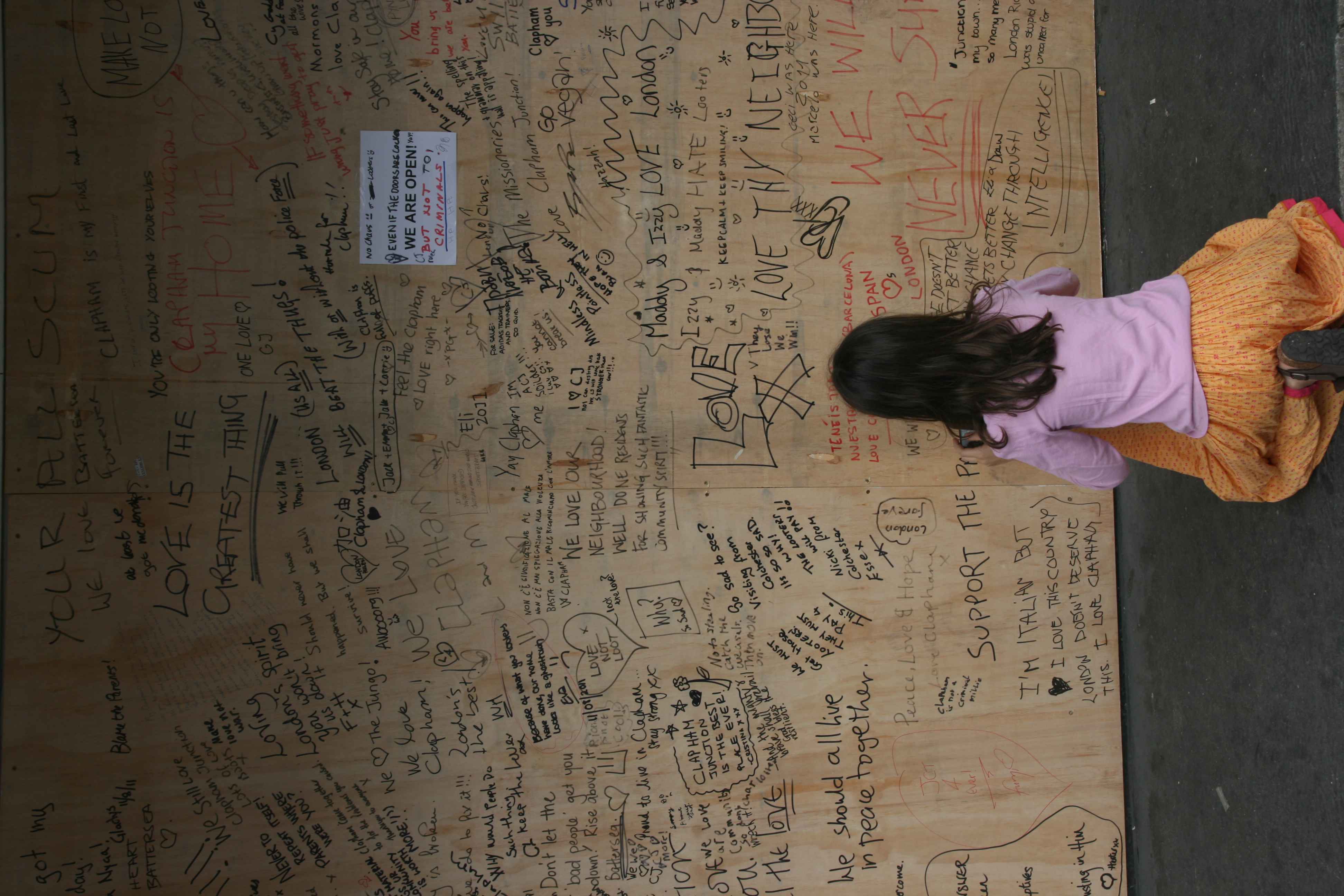
Another aspect of this episode has been a massive closing of ranks by the majority of society.  Here in Battersea (scene of the Clapham Junction riots, not, incidentally in Clapham itself, as almost universally mis-reported) masses of people turned up to help the clean-up – and the hoardings on the shops are covered in supportive graffiti (where these are bare wood; where painted they are left properly pristine!).

Supportive graffiti at TK Maxx in Clapham Junction, Battersea

This reaction seems to bridge class, race and age group.

Who can say where all this will lead?

When confidence is lost

A scary day.  Here in London people are appalled by the looting and burning, and angry and panicked.  Something analogous is going on in the world’s financial markets.  At times like this we realise how much of a modern society is built on trust and confidence in strangers.

On the streets we hope that our well-ordered and safe lives are built on more solid foundations: law and the agencies that enforce it.  But in fact it depends on almost everybody imposing voluntary boundaries on their behaviour.  Even a tiny minority can create havoc.  If it truly is a tiny minority then we can contain it, but at the cost of deadening society around us and reducing the level that different communities mix.  It’s impossible to know where we will end up, but our town centres may never recover and the divisions in our society may simply grow.

The financial markets are likewise built on trust.  We also like to think that it has more solid foundations, on decisions taken based on solid information, with effective regulation and security.  Alas no.  Decisions are taken in an instant, and often by computer algorithms with a limited digital input.  A lot has to be taken for granted, so when confidence diminishes panic is likely to follow.  One of the more irritating aspects of these markets is the way people jump to quick explanations as to why a market has moved in a particular direction.  This week there was a lot of talk about the downgrading of US debt.  But the causes are unknowable, the sum of many decisions based on partial information and individual circumstances.

The downgrading of US debt simply cannot be a rational explanation.  It was based on no new knowledge; it directly affects investors only at the margins.  US debt actually rose in price, while share markets tumbled.  Share prices had in fact mostly lost touch with reality anyway, so a sharp fall in value should hardly have been a surprise.  The ability of professional investors to accept clear nonsense as a basis for valuing shares is one of the remarkable features of modern finance.

The panic will subside.  Life must go on.  But the difficult times will continue, both in the economy and civic cohesion.


Islam and the modern world

We’ve just finished watching Rageh Omaar’s Life of Muhammad, although the BBC series finished a couple of weeks ago – the joys of the PVR.  In spite of a snarky piece in Private Eye, I really enjoyed it.  I probably know more about Islam than the vast majority in Britain, but this programme revealed how little I actually know.  And while being appropriately respectful, the programme did not shrink from posing many of the challenges made by people today.

Of course, the benchmark I measure Islam against is Christianity, about which I do know something.  Islam is clearly from the same family of religions, and like it sprang from nowhere to become one of the world’s great religions.  Unfortunately, since the programme focused on the life of Mohammed himself, we did not get much insight into how it took the world by storm, merely its eventual success in Arabia.

Islam clearly has many strengths against Christianity.  Its core narrative and doctrine is much better worked out.  Christianity is an accidental religion bursting forth from the teachings of Jesus over a very short period.  So there’s a lot of muddle at the heart, the doctrine of the trinity, the incarnation, virgin birth, and the idea of the Atonement, and so on.  Compared to this Islam is a model of clarity, with the overwhelming dominance of the one God at its heart.

Still, I had not appreciated that the Koran, the revelations of God’s word that came to Mohammed, built up over a period of quite a few years as the prophet struggled from crisis to crisis before his eventual triumph.  This leaves it with a certain amount of ambiguity, which is clearly a problem today.  What makes it worse is the idea that the Koran, as the direct word of God, is sacrosanct and incapable of being wrong.  This is an even harder doctrine than than the popular Christian one of absolute faith in their Book.

Two examples were discussed at some length in the programme.  First there was women’s dress, and the popular idea that Islam means that women should be veiled in public.  Several modern scholars popped up to say that this was not what Koran teaches, with the offending verses being both vague and explainable in context.  Set this against the absolute confidence of a fully veiled woman who believed that the more modestly she dressed, the more pleasing it was to God.  No number of urbane scholars were going to convince her otherwise.

Likewise the jihad doctrine behind terrorist movements like Al-Qaeda.  An even wider range of scholars was on hand to say that this was a misinterpretation of the idea of jihad, and that the killing of innocent bystanders was absolutely forbidden.  Again this had to be set against the conviction of a pair of young men that jihad exactly meant war against the infidel, supported by a blood-curdling looking verse from the Koran itself (which the programme flashed across the screen without reading out); they also had difficulty in accepting that there was such a thing as an innocent bystander.

This kind of irresolvable dispute is all too familiar in Christianity – consider the issues of homosexuality and women priests.   No amount of scholarship will help here, since the believers on either side feel the truth deeply in their hearts.  There is enough in the writings and doctrines of Islam to give terrorists and oppressors of women’s freedoms what they need.  But at the same time these are far from necessary implications of the faith.  In fact Islam is remarkably similar to Christianity in being a basis for all manner of good works and liberal ideas.

My understanding of Christianity is that it has a stronger pacifist element than Islam, though pacifism was not absent from Mohammed’s message.  It will, of course, be very difficult to persuade Muslims of that, given the wanton violence committed in the religion’s very name in the Crusades, and by many Christians since.  Indeed, it only recent political correctness that is taking the positive connotations away from the word “crusade” in the West.

Islamic scholars and imams clearly have a job on their hands in adapting their religion to the needs of the world around them.  But this is not an impossible task, as this wonderful religion, and the life of the great man its prophet, has all the required raw material.  We westerners should respect it more; the basics of Islam should be taught in all our schools, along with those of Christianity.  It is above all the sense of threat that drives so many followers of Islam into an extremist path.  We must reduce that feeling of threat, while standing up for women’s rights and peaceful coexistence.

Why we should celebrate the 200th anniversary of Waterloo

This isn’t exactly a new story, but, hey, time works in mysterious ways on the blogosphere.  I have just caught up with this Daily Mail article a month old suggesting the this country will downplay the 200th anniversary of Waterloo on 18th June 2015.  I picked up on it from the monthly Civitas update – they provided one of the rent-a-quotes.  This article appears to be a classic piece of Mail journalism, trying create a shock story from thin air.  But it does raise the very interesting question of the status of this battle in British history.

Waterloo is very important in British history.  But why?  The obvious answer is that it was the battle that finally did for Napoleon.  This is true, but it is undermined by two further observations.  Napoleon’s strategic position was hopeless, and if he had won at Waterloo it is certain that he would have been crushed later on in the year, most likely by an Austrian-led army.  The second point was that it wasn’t a particularly British battle.  Wellington’s army was mostly Dutch, Belgian and various shades of German, and he was combining with Blucher’s Prussian army, whose intervention was decisive.

In fact from the point of view of showcasing Wellington’s undoubted military skills, this battle wasn’t the man’s finest hour.  He was caught napping by Napoleon, needed the Prussians to slow him down at the Battle of Ligny, and had to accept huge casualties to the British contingent at Waterloo and its prequel, Quatre Bras.  His gamble at Waterloo nearly didn’t pay off as the Prussians were much slower than he expected to arrive.  British generals were supposed to keep British casualties down.  In 1811 an equally desperate, but much smaller, battle in Spain, Albuera, led to a remarkable British/allied victory thanks to some absolutely herioc fighting by British units (and some Spanish ones).  But British casualties were so high that this is often regarded at a bit of a defeat – and that was certainly the reaction of the British commander, Marshal Beresford.  It would not have been so bloody if Wellington had been there, the soldiers muttered.

But, of course, if you pay such a high price in blood you have to build the battle up to be of huge importance to justify it to folks back at home; and that is what British politicians did, with the army and a string of British historians acting as willing accomplices.  On top of that, it was a particularly dramatic battle, that has held a fascination for more than just the British.  One of the best modern histories is written by an Italian and translated into several languages.

So is it all overdone?  There is in fact something very important about this battle, that symbolises something of importance today.  It is an example of Britain acting as a fully paid-up European power, paying blood to make the whole continent a safer place alongside European allies.  A precursor to the great struggles of the 20th century: acting against the wrong sort of European unity.  In this it contrasts with Nelson’s victory at Trafalgar, which was a victory of Britain against Europe, resulting in British domination of the sea that was to last for over a century.

Waterloo was a European victory in which Britain a very full part.  A good reason to celebrate in these Eurosceptic times.